ATLAS Ouvrir dans l'atlas →

ExerciceMaths Sup – MPSI, chapitre 2 — Applications et relations binaires · Image directe et image réciproque

Exercice 7

Calcul

On note 𝕌\mathbb{U} l'ensemble des nombres complexes de module 11, et l'on considère l'application f:ℂ∗⟶ℂz⟼z+1z\begin{array}{r|ccl} f : & \mathbb{C}^{*} & \longrightarrow & \mathbb{C} \\ & z & \longmapsto & z + \dfrac{1}{z} \end{array}

1. L'application ff est-elle injective ? surjective ?

2. Déterminer f(ℝ∗)f(\mathbb{R}^{*}) et f(𝕌)f(\mathbb{U}).

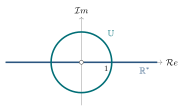
3. Déterminer f−1(ℝ)f^{-1}(\mathbb{R}), et représenter cette partie du plan.

Corrigé

1. On a f(2)=f(12)=52f(2) = f\big(\frac{1}{2}\big) = \frac{5}{2} : l'application ff n'est pas injective. Pour la surjectivité, soit w∈ℂw \in \mathbb{C}. Pour z≠0z \neq 0, f(z)=w  ⟺  z2−wz+1=0.f(z) = w \iff z^{2} - wz + 1 = 0. Cette équation du second degré possède au moins une solution dans ℂ\mathbb{C}, à condition de savoir que tout nombre complexe possède une racine carrée, ce que l'on admet ici et que le chapitre consacré aux nombres complexes établira. Ses solutions sont non nulles, car leur produit vaut 11. f n’est pas injective ; elle est surjective.\boxed{f \text{ n'est pas injective ; elle est surjective.}}

2. Pour x>0x > 0, l'inégalité x+1x⩾2x + \frac{1}{x} \geqslant 2 équivaut à (x−1)2⩾0(x - 1)^{2} \geqslant 0. Réciproquement, pour y⩾2y \geqslant 2, l'équation x2−yx+1=0x^{2} - yx + 1 = 0 a un discriminant y2−4⩾0y^{2} - 4 \geqslant 0 et des racines réelles positives. Par imparité, on obtient les valeurs ⩽−2\leqslant -2 sur ℝ−∗\mathbb{R}_{-}^{*}. Pour z=eiθ∈𝕌z = \mathrm{e}^{\mathrm{i}\theta} \in \mathbb{U}, on a 1z=e−iθ\frac{1}{z} = \mathrm{e}^{-\mathrm{i}\theta} et f(z)=2cos⁡θf(z) = 2\cos\theta, qui décrit [−2 ,2][-2\,,2]. f(ℝ∗)= ]−∞ ,−2]∪[2 ,+∞[f(𝕌)=[−2 ,2]\boxed{f(\mathbb{R}^{*}) = \,]-\infty\,,-2] \cup [2\,,+\infty[ \qquad f(\mathbb{U}) = [-2\,,2]}

3. Écrivons z=reiθz = r\mathrm{e}^{\mathrm{i}\theta} avec r>0r > 0. Alors 1z=1re−iθ\frac{1}{z} = \frac{1}{r}\mathrm{e}^{-\mathrm{i}\theta} et f(z)=(r+1r)cos⁡θ+i(r−1r)sin⁡θ.f(z) = \Big(r + \frac{1}{r}\Big)\cos\theta + \mathrm{i}\Big(r - \frac{1}{r}\Big)\sin\theta. Ainsi f(z)f(z) est réel si et seulement si r=1r = 1 ou sin⁡θ=0\sin\theta = 0, c'est-à-dire si z∈𝕌z \in \mathbb{U} ou z∈ℝ∗z \in \mathbb{R}^{*}. f−1(ℝ)=ℝ∗∪𝕌\boxed{f^{-1}(\mathbb{R}) = \mathbb{R}^{*} \cup \mathbb{U}}

Figure

La partie f−1(ℝ)f^{-1}(\mathbb{R}) est la réunion de l'axe réel privé de l'origine, en bleu ardoise, et du cercle unité, en bleu pétrole : ce sont les seuls points où la partie imaginaire de z+1zz + \frac{1}{z} s'annule.

Dans l'édifice

Thèmes

image directe et image réciproque, images directes et réciproques, injectivité, surjectivité

Notions

image directe, image réciproque, injection, surjection

Ouvrir dans l'atlas interactif →