ATLAS Ouvrir dans l'atlas →

ExerciceMaths Sup – MPSI, chapitre 4 — Nombres complexes et trigonométrie · Racines nn-ièmes

Exercice 38

Calcul

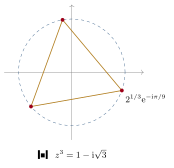
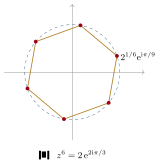
Résoudre dans ℂ\mathbb{C} les équations suivantes, et représenter les solutions des deux premières dans le plan complexe.

(a) z3=1−i3z^{3} = 1 - \mathrm{i}\sqrt{3}

(b) z6=−41+i3z^{6} = \dfrac{-4}{1 + \mathrm{i}\sqrt{3}}

(c) z8=1+i3−iz^{8} = \dfrac{1 + \mathrm{i}}{\sqrt{3} - \mathrm{i}}

(d) z4=−7+24iz^{4} = -7 + 24\mathrm{i}, sous forme algébrique

Corrigé

On met le second membre sous forme trigonométrique r eiθr\,\mathrm{e}^{\mathrm{i}\theta}, puis l'on applique la proposition 22 du cours : les solutions sont les r1/n ei(θ+2kπ)/nr^{1/n}\,\mathrm{e}^{\mathrm{i}(\theta + 2k\pi)/n}, k∈[ ⁣[0 ;n−1] ⁣]k \in [\![0\,;n-1]\!].

• (a) 1−i3=2 e−iπ/31 - \mathrm{i}\sqrt{3} = 2\,\mathrm{e}^{-\mathrm{i}\pi/3} : z=21/3 ei(−π/9+2kπ/3), k∈{0,1,2}\boxed{z = 2^{1/3}\,\mathrm{e}^{\mathrm{i}(-\pi/9 + 2k\pi/3)},\ k \in \{0, 1, 2\}}

• (b) −42 eiπ/3=−2 e−iπ/3=2 e2iπ/3\dfrac{-4}{2\,\mathrm{e}^{\mathrm{i}\pi/3}} = -2\,\mathrm{e}^{-\mathrm{i}\pi/3} = 2\,\mathrm{e}^{2\mathrm{i}\pi/3} : z=21/6 ei(π/9+kπ/3), k∈[ ⁣[0 ;5] ⁣]\boxed{z = 2^{1/6}\,\mathrm{e}^{\mathrm{i}(\pi/9 + k\pi/3)},\ k \in [\![0\,;5]\!]}

• (c) 2 eiπ/42 e−iπ/6=2−1/2 e5iπ/12\dfrac{\sqrt{2}\,\mathrm{e}^{\mathrm{i}\pi/4}}{2\,\mathrm{e}^{-\mathrm{i}\pi/6}} = 2^{-1/2}\,\mathrm{e}^{5\mathrm{i}\pi/12} : z=2−1/16 ei(5π/96+kπ/4), k∈[ ⁣[0 ;7] ⁣]\boxed{z = 2^{-1/16}\,\mathrm{e}^{\mathrm{i}(5\pi/96 + k\pi/4)},\ k \in [\![0\,;7]\!]}

• (d) On cherche d'abord Z=z2Z = z^{2} tel que Z2=−7+24iZ^{2} = -7 + 24\mathrm{i} : Z=±(3+4i)Z = \pm(3 + 4\mathrm{i}). Les racines carrées de 3+4i3 + 4\mathrm{i} sont ±(2+i)\pm(2 + \mathrm{i}), celles de −3−4i-3 - 4\mathrm{i} sont ±(1−2i)\pm(1 - 2\mathrm{i}). z∈{2+i, −2−i, 1−2i, −1+2i}\boxed{z \in \{2 + \mathrm{i},\ -2 - \mathrm{i},\ 1 - 2\mathrm{i},\ -1 + 2\mathrm{i}\}} On constate que 1−2i=−i(2+i)1 - 2\mathrm{i} = -\mathrm{i}(2 + \mathrm{i}) : les quatre solutions sont les produits de 2+i2 + \mathrm{i} par les éléments de 𝕌4\mathbb{U}_{4}.

Figure
Figure

Les solutions de (a) forment un triangle équilatéral, celles de (b) un hexagone régulier, inscrits dans les cercles de rayons 21/3≈1,262^{1/3} \approx 1{,}26 et 21/6≈1,122^{1/6} \approx 1{,}12 ; on passe d'une solution à la suivante par une rotation d'angle 2πn\frac{2\pi}{n}.

Ouvrir dans l'atlas interactif →