ATLAS Ouvrir dans l'atlas →

ExercicePremière, chapitre 7 — Produit scalaire · Définition géométrique

Exercice 8

Calcul

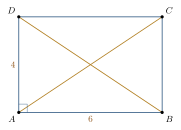
ABCDABCD est un rectangle tel que AB=6AB=6 et AD=4AD=4.

Figure

1. En utilisant à chaque fois le projeté orthogonal, calculer :

(a) AB→⋅AC→\overrightarrow{AB}\cdot\overrightarrow{AC}

(b) AB→⋅AD→\overrightarrow{AB}\cdot\overrightarrow{AD}

(c) AD→⋅AC→\overrightarrow{AD}\cdot\overrightarrow{AC}

(d) AB→⋅DC→\overrightarrow{AB}\cdot\overrightarrow{DC}

Pour a), on commencera par identifier le projeté orthogonal de CC sur (AB)(AB).

2. On munit le plan du repère orthonormé (A ;16AB→,14AD→)\left(A\,;\dfrac{1}{6}\overrightarrow{AB}, \dfrac{1}{4}\overrightarrow{AD}\right), dans lequel A(0 ;0)A(0\,;0), B(6 ;0)B(6\,;0), C(6 ;4)C(6\,;4) et D(0 ;4)D(0\,;4). Retrouver les quatre résultats précédents par le calcul avec les coordonnées.

3. Calculer de même AC→⋅BD→\overrightarrow{AC}\cdot\overrightarrow{BD}. Les diagonales d'un rectangle sont-elles perpendiculaires ? Et celles d'un carré ?

Corrigé

1. (a) Le projeté orthogonal de CC sur (AB)(AB) est BB, et AB→\overrightarrow{AB}, AB→\overrightarrow{AB} ont évidemment le même sens : AB→⋅AC→=AB→⋅AB→=AB2=36\overrightarrow{AB}\cdot\overrightarrow{AC}=\overrightarrow{AB}\cdot\overrightarrow{AB}=AB^{2}=\boxed{36}

(b) Les côtés [AB][AB] et [AD][AD] sont perpendiculaires : AB→⋅AD→=0\boxed{\overrightarrow{AB}\cdot\overrightarrow{AD}=0}

(c) Le projeté orthogonal de CC sur (AD)(AD) est DD : AD→⋅AC→=AD→⋅AD→=AD2=16\overrightarrow{AD}\cdot\overrightarrow{AC}=\overrightarrow{AD}\cdot\overrightarrow{AD}=AD^{2}=\boxed{16}

(d) DC→=AB→\overrightarrow{DC}=\overrightarrow{AB} (le quadrilatère est un rectangle) : AB→⋅DC→=AB→⋅AB→=36\overrightarrow{AB}\cdot\overrightarrow{DC}=\overrightarrow{AB}\cdot\overrightarrow{AB}=\boxed{36}

2. Dans le repère proposé, AB→(60)\overrightarrow{AB}\begin{pmatrix} 6 \\ 0 \end{pmatrix}, AD→(04)\overrightarrow{AD}\begin{pmatrix} 0 \\ 4 \end{pmatrix}, AC→(64)\overrightarrow{AC}\begin{pmatrix} 6 \\ 4 \end{pmatrix} et DC→(60)\overrightarrow{DC}\begin{pmatrix} 6 \\ 0 \end{pmatrix}. La proposition 5 donne alors : 6×6+0×4=36;6×0+0×4=0;0×6+4×4=16;6×6+0×0=366\times 6+0\times 4=36 \quad ; \quad 6\times 0+0\times 4=0 \quad ; \quad 0\times 6+4\times 4=16 \quad ; \quad 6\times 6+0\times 0=36 On retrouve bien les quatre résultats précédents.

3. AC→(64)\overrightarrow{AC}\begin{pmatrix} 6 \\ 4 \end{pmatrix} et BD→(−64)\overrightarrow{BD}\begin{pmatrix} -6 \\ 4 \end{pmatrix} : AC→⋅BD→=6×(−6)+4×4=−36+16=−20\overrightarrow{AC}\cdot\overrightarrow{BD}=6\times(-6)+4\times 4=-36+16=\boxed{-20} Ce produit n'étant pas nul : les diagonales d’un rectangle ne sont pas perpendiculaires\boxed{\text{les diagonales d'un rectangle ne sont pas perpendiculaires}}.

Dans un carré en revanche, AB=ADAB=AD, et le calcul devient AB2−AD2=0AB^{2}-AD^{2}=0 : les diagonales sont bien perpendiculaires. C'est d'ailleurs ce que démontre l'exercice 18 pour un losange quelconque.

Dans l'édifice

Thèmes

produit scalaire, projeté orthogonal, angle et cosinus, orthogonalité, expression analytique

Notions

produit scalaire

Ouvrir dans l'atlas interactif →