ATLAS Ouvrir dans l'atlas →

ExercicePremière, chapitre 7 — Produit scalaire · Définition géométrique

Exercice 4

Calcul

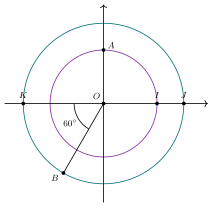
On a construit la figure ci-dessous en traçant deux cercles de centre OO tels que OI=2OI=2 et OJ=3OJ=3. Les points II, JJ et KK appartiennent à l'axe horizontal, le point AA à l'axe vertical, et (OK→,OB→)=−60∘\left(\overrightarrow{OK},\overrightarrow{OB}\right)=-60^{\circ}.

Figure

Calculer les produits scalaires suivants. On donnera des valeurs exactes.

a) OI→⋅OJ→\overrightarrow{OI}\cdot\overrightarrow{OJ}

b) OI→⋅OK→\overrightarrow{OI}\cdot\overrightarrow{OK}

c) OI→⋅OB→\overrightarrow{OI}\cdot\overrightarrow{OB}

d) OB→⋅OA→\overrightarrow{OB}\cdot\overrightarrow{OA}

e) OA→⋅AI→\overrightarrow{OA}\cdot\overrightarrow{AI}

f) IA→⋅IJ→\overrightarrow{IA}\cdot\overrightarrow{IJ}

Pour e) et f), les deux vecteurs n'ont pas la même origine : on commencera par les redessiner à partir d'un même point.

Corrigé

On repère d'abord les longueurs : OI=2OI=2, OA=2OA=2 (le point AA est sur le petit cercle), OJ=OK=OB=3OJ=OK=OB=3 (les trois autres sont sur le grand cercle).

a) OI→\overrightarrow{OI} et OJ→\overrightarrow{OJ} sont colinéaires de même sens : OI→⋅OJ→=2×3=6\overrightarrow{OI}\cdot\overrightarrow{OJ}=2\times 3=\boxed{6}

b) OI→\overrightarrow{OI} et OK→\overrightarrow{OK} sont colinéaires de sens contraires : OI→⋅OK→=−2×3=−6\overrightarrow{OI}\cdot\overrightarrow{OK}=-2\times 3=\boxed{-6}

c) L'angle (OK→,OB→)\left(\overrightarrow{OK},\overrightarrow{OB}\right) mesure −60∘-60^{\circ}, et OK→\overrightarrow{OK} est opposé à OI→\overrightarrow{OI}, donc (OI→,OB→)=180∘−60∘=120∘\left(\overrightarrow{OI},\overrightarrow{OB}\right)=180^{\circ}-60^{\circ} =120^{\circ} : OI→⋅OB→=2×3×cos⁡(120∘)=−3\overrightarrow{OI}\cdot\overrightarrow{OB}=2\times 3\times\cos(120^{\circ})=\boxed{-3}

d) Le point AA étant sur l'axe vertical, (OI→,OA→)=90∘\left(\overrightarrow{OI},\overrightarrow{OA}\right)=90^{\circ}, d'où (OB→,OA→)=120∘+90∘=210∘\left(\overrightarrow{OB},\overrightarrow{OA}\right)=120^{\circ}+90^{\circ}=210^{\circ}, dont le cosinus vaut celui de 150∘150^{\circ} : OB→⋅OA→=3×2×(−32)=−33≈−5,20\overrightarrow{OB}\cdot\overrightarrow{OA}=3\times 2\times\left(-\frac{\sqrt{3}}{2}\right) =\boxed{-3\sqrt{3}\approx -5{,}20}

e) Les deux vecteurs n'ont pas la même origine. Le triangle OAIOAI est rectangle isocèle en OO (car OA=OI=2OA=OI=2), donc ses angles à la base valent 45∘45^{\circ}, et AI=22AI=2\sqrt{2}. L'angle entre OA→\overrightarrow{OA} et AI→\overrightarrow{AI} vaut alors 180∘−45∘=135∘180^{\circ}-45^{\circ}=135^{\circ} : OA→⋅AI→=2×22×(−22)=−4\overrightarrow{OA}\cdot\overrightarrow{AI}=2\times 2\sqrt{2}\times\left(-\frac{\sqrt{2}}{2}\right)=\boxed{-4}

f) De même, (IA→,IJ→)=180∘−45∘=135∘\left(\overrightarrow{IA},\overrightarrow{IJ}\right)=180^{\circ}-45^{\circ}=135^{\circ}, avec IA=22IA=2\sqrt{2} et IJ=OJ−OI=1IJ=OJ-OI=1 : IA→⋅IJ→=22×1×(−22)=−2\overrightarrow{IA}\cdot\overrightarrow{IJ}=2\sqrt{2}\times 1\times\left(-\frac{\sqrt{2}}{2}\right) =\boxed{-2}

On peut contrôler ces six résultats en plaçant un repère orthonormé d'origine OO : on a alors I(2 ;0)I(2\,;0), J(3 ;0)J(3\,;0), K(−3 ;0)K(-3\,;0), A(0 ;2)A(0\,;2) et B(−32 ;−332)B\left(-\dfrac{3}{2}\,;-\dfrac{3\sqrt{3}}{2}\right).

Dans l'édifice

Thèmes

produit scalaire, équations de cercles

Notions

norme, produit scalaire

Ouvrir dans l'atlas interactif →