ATLAS Ouvrir dans l'atlas →

ExercicePremière, chapitre 7 — Produit scalaire · Approche analytique

Exercice 10

Calcul

Dans un repère orthonormé, on considère les points A(−1 ;2)A(-1\,;2), B(3 ;4)B(3\,;4) et C(2 ;−1)C(2\,;-1).

1. Placer ces trois points dans un repère.

2. Déterminer les coordonnées des vecteurs AB→\overrightarrow{AB}, AC→\overrightarrow{AC} et BC→\overrightarrow{BC}.

3. Calculer AB→⋅AC→\overrightarrow{AB}\cdot\overrightarrow{AC}, BA→⋅BC→\overrightarrow{BA}\cdot\overrightarrow{BC} et CA→⋅CB→\overrightarrow{CA}\cdot\overrightarrow{CB}.

4. Calculer les longueurs ABAB, ACAC et BCBC. Le triangle ABCABC semble-t-il particulier ?

Corrigé

1. Voici la figure.
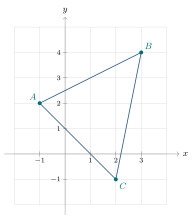
Figure

2. On soustrait les coordonnées du point de départ à celles du point d'arrivée : AB→(42);AC→(3−3);BC→(−1−5)\boxed{\overrightarrow{AB}\begin{pmatrix} 4 \\ 2 \end{pmatrix} \quad ; \quad \overrightarrow{AC}\begin{pmatrix} 3 \\ -3 \end{pmatrix} \quad ; \quad \overrightarrow{BC}\begin{pmatrix} -1 \\ -5 \end{pmatrix}}

3. AB→⋅AC→=4×3+2×(−3)=12−6=6\overrightarrow{AB}\cdot\overrightarrow{AC}=4\times 3+2\times(-3)=12-6=\boxed{6} Pour le deuxième, il faut BA→(−4−2)\overrightarrow{BA}\begin{pmatrix} -4 \\ -2 \end{pmatrix} : BA→⋅BC→=(−4)×(−1)+(−2)×(−5)=4+10=14\overrightarrow{BA}\cdot\overrightarrow{BC}=(-4)\times(-1)+(-2)\times(-5)=4+10=\boxed{14} Et avec CA→(−33)\overrightarrow{CA}\begin{pmatrix} -3 \\ 3 \end{pmatrix} et CB→(15)\overrightarrow{CB}\begin{pmatrix} 1 \\ 5 \end{pmatrix} : CA→⋅CB→=−3×1+3×5=−3+15=12\overrightarrow{CA}\cdot\overrightarrow{CB}=-3\times 1+3\times 5=-3+15=\boxed{12}

4. AB=42+22=20=25≈4,47AB=\sqrt{4^{2}+2^{2}}=\boxed{\sqrt{20}=2\sqrt{5}\approx 4{,}47}

AC=32+(−3)2=18=32≈4,24AC=\sqrt{3^{2}+(-3)^{2}}=\boxed{\sqrt{18}=3\sqrt{2}\approx 4{,}24}

BC=(−1)2+(−5)2=26≈5,10BC=\sqrt{(-1)^{2}+(-5)^{2}}=\boxed{\sqrt{26}\approx 5{,}10} Les trois longueurs sont différentes et aucun des trois produits scalaires n'est nul : le triangle ABC n’a rien de particulier\boxed{\text{le triangle } ABC \text{ n'a rien de particulier}}

Dans l'édifice

Thèmes

produit scalaire, norme, angle et cosinus, expression analytique

Notions

norme, produit scalaire

Ouvrir dans l'atlas interactif →