ATLAS Ouvrir dans l'atlas →

ExerciceMaths expertes, chapitre 9 — Chaînes de Markov · Calcul de distributions

Exercice 7

Lecture graphiqueCalcul

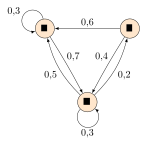
On considère une chaîne de Markov (Xn)(X_{n}) admettant le graphe probabiliste ci-contre.

1. On a P(X0=A)=0,2P(X_{0}=A)=0{,}2 et P(X0=B)=0,5P(X_{0}=B)=0{,}5.

Déterminer les probabilités suivantes :

(a) P(X1=A)P(X_{1}=A)

(b) P(X1=B)P(X_{1}=B)

(c) P(X1=C)P(X_{1}=C)

(d) P(X2=A)P(X_{2}=A)

2. Déterminer la matrice de transition MM associée à cette chaîne de Markov.

Figure
Corrigé

1. Comme P(X0=A)+P(X0=B)+P(X0=C)=1P(X_{0}=A)+P(X_{0}=B)+P(X_{0}=C)=1, on a P(X0=C)=1−0,2−0,5=0,3P(X_{0}=C)=1-0{,}2-0{,}5=0{,}3, d'où π0=(0,20,50,3)\pi_{0}=\begin{pmatrix} 0{,}2 & 0{,}5 & 0{,}3 \end{pmatrix}.

On lit sur le graphe les probabilités d'arriver en chaque état, à l'aide de la formule des probabilités totales.

(a) P(X1=A)=0,2×0,3+0,5×0,7+0,3×0,4=0,06+0,35+0,12=0,53P(X_{1}=A)=0{,}2\times 0{,}3+0{,}5\times 0{,}7+0{,}3\times 0{,}4 =0{,}06+0{,}35+0{,}12=\boxed{0{,}53}

(b) P(X1=B)=0,2×0,5+0,5×0,3+0,3×0,6=0,10+0,15+0,18=0,43P(X_{1}=B)=0{,}2\times 0{,}5+0{,}5\times 0{,}3+0{,}3\times 0{,}6 =0{,}10+0{,}15+0{,}18=\boxed{0{,}43}

(c) P(X1=C)=0,2×0,2+0,5×0+0,3×0=0,04P(X_{1}=C)=0{,}2\times 0{,}2+0{,}5\times 0+0{,}3\times 0=\boxed{0{,}04} On vérifie : 0,53+0,43+0,04=10{,}53+0{,}43+0{,}04=1.

(d) On repart de π1=(0,530,430,04)\pi_{1}=\begin{pmatrix} 0{,}53 & 0{,}43 & 0{,}04 \end{pmatrix} : P(X2=A)=0,53×0,3+0,43×0,7+0,04×0,4=0,159+0,301+0,016=0,476P(X_{2}=A)=0{,}53\times 0{,}3+0{,}43\times 0{,}7+0{,}04\times 0{,}4 =0{,}159+0{,}301+0{,}016=\boxed{0{,}476}

2. On lit les arêtes partant de chaque sommet : M=(0,30,50,20,70,300,40,60)\boxed{M=\begin{pmatrix} 0{,}3 & 0{,}5 & 0{,}2 \\ 0{,}7 & 0{,}3 & 0 \\ 0{,}4 & 0{,}6 & 0 \end{pmatrix}} Les deux zéros de la dernière colonne traduisent qu'aucune arête n'arrive en CC depuis BB ou depuis CC : une fois quitté, l'état CC ne peut être atteint que depuis AA.

On retrouve alors les résultats de la question 1 par le calcul matriciel : π1=π0M=(0,530,430,04);π2=π1M=(0,4760,4180,106)\pi_{1}=\pi_{0}M=\begin{pmatrix} 0{,}53 & 0{,}43 & 0{,}04 \end{pmatrix} \qquad ; \qquad \pi_{2}=\pi_{1}M=\begin{pmatrix} 0{,}476 & 0{,}418 & 0{,}106 \end{pmatrix}

Ouvrir dans l'atlas interactif →