ATLAS Ouvrir dans l'atlas →

ExercicePremière, chapitre 4 — Dérivation · Dérivée, variations et extremums

Exercice 23

Calcul

Pour chacune des fonctions suivantes, définie sur ℝ\mathbb{R} : calculer f′f', étudier son signe, dresser le tableau de variations de ff, puis préciser l'extremum obtenu.

a) f(x)=x2−4x+3f(x)=x^{2}-4x+3

b) f(x)=−2x2+8x−5f(x)=-2x^{2}+8x-5

c) f(x)=3x2+6x+1f(x)=3x^{2}+6x+1

d) f(x)=−x2+6xf(x)=-x^{2}+6x

Corrigé

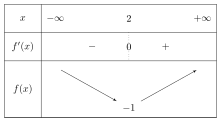
a) f′(x)=2x−4f'(x)=2x-4, qui s'annule en 22 et est positive après.

Figure

Minimum −1 atteint en x=2.\boxed{\text{Minimum } -1 \text{ atteint en } x=2.}

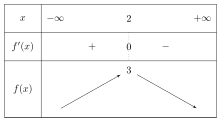
b) f′(x)=−4x+8f'(x)=-4x+8, qui s'annule en 22 et est négative après.

Figure

Maximum 3 atteint en x=2.\boxed{\text{Maximum } 3 \text{ atteint en } x=2.}

c) f′(x)=6x+6f'(x)=6x+6, qui s'annule en −1-1 : minimum −2 atteint en x=−1\boxed{\text{minimum } -2 \text{ atteint en } x=-1}, ff décroissante sur ]−∞ ;−1]]-\infty\,;-1] puis croissante sur [−1 ;+∞[[-1\,;+\infty[.

d) f′(x)=−2x+6f'(x)=-2x+6, qui s'annule en 33 : maximum 9 atteint en x=3\boxed{\text{maximum } 9 \text{ atteint en } x=3}, ff croissante puis décroissante.

Dans l'édifice

Thèmes

fonction dérivée, variations, extremums

Notions

dérivable, extremum local

Ouvrir dans l'atlas interactif →