ATLAS Ouvrir dans l'atlas →

ExercicePremière, chapitre 8 — Fonction exponentielle · Dérivation

Exercice 19

Calcul

Pour chacune des fonctions suivantes, définies sur ℝ\mathbb{R} : calculer la dérivée, la factoriser, étudier son signe, puis dresser le tableau de variations de ff en précisant les extremums.

1. f(x)=(x−2)exf(x)=(x-2)\mathrm{e}^{x}

2. f(x)=e−x2f(x)=\mathrm{e}^{-x^{2}}

3. f(x)=xe−xf(x)=x\mathrm{e}^{-x}

Corrigé

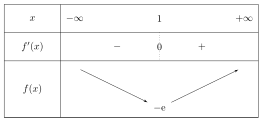
1. f(x)=(x−2)exf(x)=(x-2)\mathrm{e}^{x}. f′(x)=ex+(x−2)ex=(x−1)exf'(x)=\mathrm{e}^{x}+(x-2)\mathrm{e}^{x}=\boxed{(x-1)\mathrm{e}^{x}} Comme ex>0\mathrm{e}^{x}>0, f′(x)f'(x) est du signe de x−1x-1.

Figure
f admet un minimum eˊgal aˋ f(1)=−e≈−2,72, atteint en x=1\boxed{f \text{ admet un minimum égal à } f(1)=-\mathrm{e}\approx -2{,}72, \text{ atteint en } x=1}

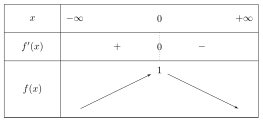
2. f(x)=e−x2f(x)=\mathrm{e}^{-x^{2}}, avec u=−x2u=-x^{2} et u′=−2xu'=-2x : f′(x)=−2x e−x2f'(x)=\boxed{-2x\,\mathrm{e}^{-x^{2}}} Comme e−x2>0\mathrm{e}^{-x^{2}}>0, f′(x)f'(x) est du signe de −2x-2x, donc positif si x<0x<0.

Figure
f admet un maximum eˊgal aˋ f(0)=e0=1, atteint en x=0\boxed{f \text{ admet un maximum égal à } f(0)=\mathrm{e}^{0}=1, \text{ atteint en } x=0}

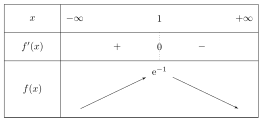
3. f(x)=xe−xf(x)=x\mathrm{e}^{-x}. f′(x)=e−x−x e−x=(1−x)e−xf'(x)=\mathrm{e}^{-x}-x\,\mathrm{e}^{-x}=\boxed{(1-x)\mathrm{e}^{-x}} Comme e−x>0\mathrm{e}^{-x}>0, f′(x)f'(x) est du signe de 1−x1-x, donc positif si x<1x<1.

Figure
f admet un maximum eˊgal aˋ f(1)=e−1≈0,37, atteint en x=1\boxed{f \text{ admet un maximum égal à } f(1)=\mathrm{e}^{-1}\approx 0{,}37, \text{ atteint en } x=1}
Ouvrir dans l'atlas interactif →