ATLAS Ouvrir dans l'atlas →

ExerciceTerminale, chapitre 6 — Calcul intégral · Exercices de synthèse

Exercice 34 Type Bac

Type BacCalcul

Dans un repère orthonormé, on note 𝒞\mathcal{C} la courbe de la fonction ln⁡\ln et 𝒟\mathcal{D} la droite d'équation y=x−1y=x-1. On s'intéresse au domaine compris entre 𝒞\mathcal{C} et 𝒟\mathcal{D} pour xx variant de 11 à e\mathrm{e}.

Partie A : position relative.

1. On pose h(x)=x−1−ln⁡(x)h(x)=x-1-\ln(x) pour x∈[1 ;e]x\in[1\,;\mathrm{e}]. Calculer h′(x)h'(x) et étudier son signe.

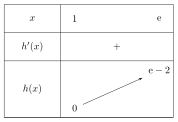
2. Dresser le tableau de variations de hh sur [1 ;e][1\,;\mathrm{e}].

3. En déduire la position relative de 𝒞\mathcal{C} et de 𝒟\mathcal{D} sur [1 ;e][1\,;\mathrm{e}].

Partie B : calcul de l'aire.

4. Calculer ∫1eln⁡(x) dx\displaystyle\int_{1}^{\mathrm{e}}\ln(x)\,\mathrm{d}x à l'aide d'une intégration par parties.

5. Calculer ∫1e(x−1) dx\displaystyle\int_{1}^{\mathrm{e}}(x-1)\,\mathrm{d}x.

6. En déduire l'aire, en unités d'aire, du domaine compris entre 𝒞\mathcal{C} et 𝒟\mathcal{D} sur [1 ;e][1\,;\mathrm{e}]. On donnera la valeur exacte, puis une valeur approchée au millième.

Partie C : valeur moyenne.

7. Calculer la valeur moyenne de la fonction ln⁡\ln sur [1 ;e][1\,;\mathrm{e}].

8. Cette valeur moyenne est-elle atteinte par la fonction ln⁡\ln sur [1 ;e][1\,;\mathrm{e}] ? Si oui, en quel réel ?

Corrigé

Partie A : position relative.

1. h(x)=x−1−ln⁡(x)h(x)=x-1-\ln(x) donne h′(x)=1−1x=x−1xh'(x)=1-\dfrac{1}{x}=\dfrac{x-1}{x}. Sur [1 ;e][1\,;\mathrm{e}], le dénominateur est strictement positif et le numérateur est positif : h′(x)⩾0 sur [1 ;e]\boxed{h'(x)\geqslant 0 \text{ sur } [1\,;\mathrm{e}]}

2. h(1)=1−1−ln⁡(1)=0h(1)=1-1-\ln(1)=0 et h(e)=e−1−1=e−2≈0,718h(\mathrm{e})=\mathrm{e}-1-1=\mathrm{e}-2\approx 0{,}718.

Figure

3. La fonction hh est croissante sur [1 ;e][1\,;\mathrm{e}] et vaut 00 en 11 : elle est donc positive sur tout l'intervalle. Or h(x)=(x−1)−ln⁡(x)h(x)=(x-1)-\ln(x) : Sur [1 ;e],  𝒟 est au-dessus de 𝒞\boxed{\text{Sur } [1\,;\mathrm{e}],\; \mathcal{D} \text{ est au-dessus de } \mathcal{C}} Les deux courbes se touchent en x=1x=1, au point de coordonnées (1 ;0)(1\,;0).

Partie B : calcul de l'aire.

4. On écrit ln⁡(x)=1×ln⁡(x)\ln(x)=1\times\ln(x) : {u(x)=ln⁡(x)u′(x)=1x{v′(x)=1v(x)=x\left\{\begin{array}{l} u(x)=\ln(x) \\[2mm] u'(x)=\dfrac{1}{x} \end{array}\right. \qquad\qquad \left\{\begin{array}{l} v'(x)=1 \\[2mm] v(x)=x \end{array}\right.

∫1eln⁡(x) dx=[xln⁡(x)]1e−∫1e1 dx=e−[x]1e=e−(e−1)=1\int_{1}^{\mathrm{e}}\ln(x)\,\mathrm{d}x=\Big[x\ln(x)\Big]_{1}^{\mathrm{e}}-\int_{1}^{\mathrm{e}}1\,\mathrm{d}x =\mathrm{e}-\Big[x\Big]_{1}^{\mathrm{e}}=\mathrm{e}-(\mathrm{e}-1)=\boxed{1}

5. ∫1e(x−1) dx=[x22−x]1e=(e22−e)−(12−1)=e22−e+12≈1,476\int_{1}^{\mathrm{e}}(x-1)\,\mathrm{d}x=\left[\frac{x^{2}}{2}-x\right]_{1}^{\mathrm{e}} =\left(\frac{\mathrm{e}^{2}}{2}-\mathrm{e}\right)-\left(\frac{1}{2}-1\right) =\boxed{\frac{\mathrm{e}^{2}}{2}-\mathrm{e}+\frac{1}{2}\approx 1{,}476}

6. La droite étant au-dessus de la courbe, l'aire est l'intégrale de la différence : 𝒜=∫1e((x−1)−ln⁡(x))dx=∫1e(x−1) dx−∫1eln⁡(x) dx=(e22−e+12)−1=e22−e−12≈0,476 u.a.\begin{aligned} \mathcal{A} &= \int_{1}^{\mathrm{e}}\Big((x-1)-\ln(x)\Big)\mathrm{d}x = \int_{1}^{\mathrm{e}}(x-1)\,\mathrm{d}x-\int_{1}^{\mathrm{e}}\ln(x)\,\mathrm{d}x \\ &= \left(\frac{\mathrm{e}^{2}}{2}-\mathrm{e}+\frac{1}{2}\right)-1 = \boxed{\frac{\mathrm{e}^{2}}{2}-\mathrm{e}-\frac{1}{2}\approx 0{,}476 \text{ u.a.}} \end{aligned}

Partie C : valeur moyenne.

7. μ=1e−1∫1eln⁡(x) dx=1e−1≈0,582\mu=\frac{1}{\mathrm{e}-1}\int_{1}^{\mathrm{e}}\ln(x)\,\mathrm{d}x =\boxed{\frac{1}{\mathrm{e}-1}\approx 0{,}582}

8. La fonction ln⁡\ln est continue et strictement croissante sur [1 ;e][1\,;\mathrm{e}], où elle varie de 00 à 11. Comme 0<μ<10<\mu<1, le théorème des valeurs intermédiaires assure qu'il existe un unique réel cc de [1 ;e][1\,;\mathrm{e}] tel que ln⁡(c)=μ\ln(c)=\mu : c=e1e−1≈1,789\boxed{c=\mathrm{e}^{\frac{1}{\mathrm{e}-1}}\approx 1{,}789}

Oui, la valeur moyenne est atteinte, en c≈1,79\boxed{\text{Oui, la valeur moyenne est atteinte, en } c\approx 1{,}79}

Dans l'édifice

Thèmes

intégrale, aire, valeur moyenne, intégration par parties, exponentielle, logarithme, tableau de variations

Notions

intégrable au sens de Riemann, exponentielle, logarithme

Ouvrir dans l'atlas interactif →